
Blog, Pitang.

Marcelo Almeida - REVL
AI and Cybersecurity in 2026: What Changes When Machines Protect and Attack Machines
Cybersecurity

AI and Cybersecurity in 2026: What Changes When Machines Protect and Attack Machines
We are entering a phase where AI is no longer just a tool, but is beginning to act as an agent in both defense and offense.
Decisions are made at machine speed. Actions occur without human intervention. And the attack surface expands in direct proportion to the increase in efficiency.
Recent reports, such as the one from Palo Alto Networks, provide forecasts for 2026 that help put a name to this movement. Not as definitive truths, but as clear signals of changes that are already beginning to manifest in the daily lives of cybersecurity professionals.
Understanding these changes is not a theoretical exercise. It is a prerequisite for continuing to operate with confidence in increasingly automated environments.
When Digital Identity Ceases to Be Trustworthy
One of the most significant trends at the intersection of AI and cybersecurity is the weakening of digital identity.
With increasingly sophisticated deepfakes and autonomous agents operating at scale, distinguishing what is real from what has been fabricated becomes a concrete challenge.
Imagine receiving an audio message, or even a video, from your company's CEO requesting urgent action. The voice is identical. The image is convincing. The context is plausible. Yet, it is not real.
This type of situation is already happening. And the trend is that it will become increasingly common and harder to identify.
The challenge goes beyond technology: it is about how to establish trust in environments where authenticity can be simulated with a high degree of precision.
The New Target: AI Agents with Privileged Access
Another critical point concerns the AI agents themselves that companies have been adopting.
Systems designed to operate autonomously, with broad access to critical data and processes, become natural targets. In addition to phishing techniques that exploit the human factor, there is now also the possibility of directly compromising these agents, without any human interaction.
A system created to support decisions can, if manipulated, cause significant damage. And, given the speed at which AI agents operate, this can happen before anyone realizes it in time.
It is not about abandoning automation or intelligent agents. It is about recognizing that new capabilities bring new risks, and that these risks must be considered from the solution's design stage.
AI Governance in Cybersecurity: A Gap That Exacts Its Toll
The Palo Alto Networks report highlights a concerning figure: Only 6% of organizations have a mature security strategy specifically focused on artificial intelligence.
This means that most companies are adopting AI agents and tools without clear policies on governance, monitoring, or operational boundaries.
This is not necessarily an intentional oversight; it is a reflection of the speed at which technology has advanced. However, the absence of guidelines tends to take its toll. The later these policies are defined, the greater the effort required to fix what is already in production.
What a Mature AI and Cybersecurity Strategy Considers
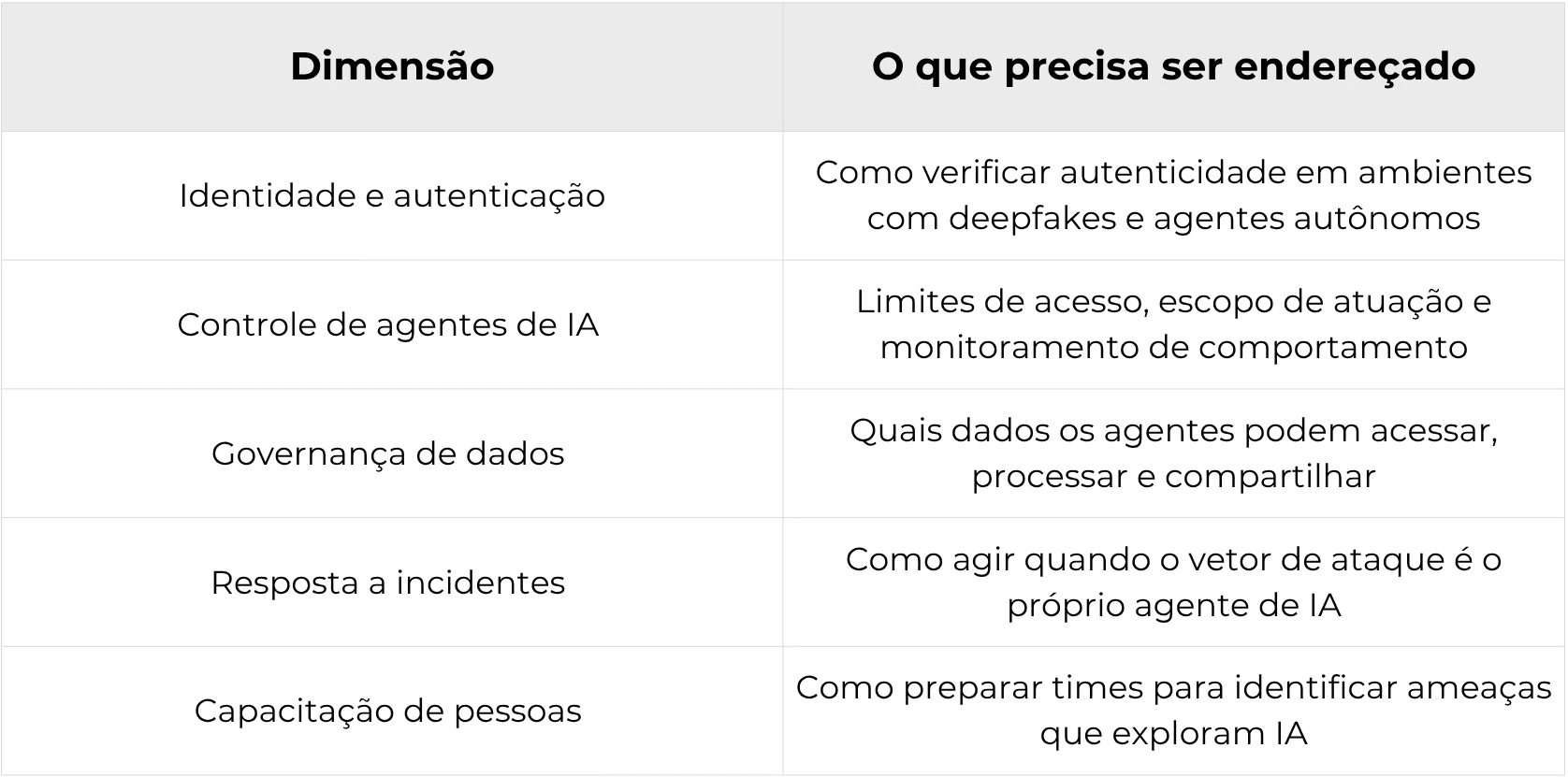
What All of This Means in Practice
If there is a central message in these predictions, it is that security cannot be treated as an isolated topic.
It needs to be integrated into how the company uses technology, from the selection of tools to data governance, as well as workforce training.
There is no single solution for this scenario. But there is a clear posture: in a world where AI accelerates both defense and offense, the advantage belongs to those who can anticipate moves, establish boundaries, and act in an integrated manner.
The Role of REVL Security in This Scenario
At REVL Security, Pitang's cybersecurity arm, we start from a simple principle: You cannot protect what you cannot see clearly.
Uncovering what is hidden—whether it is a technical flaw, a process gap, or an emerging risk—is the first step toward any consistent security strategy.
In a context where AI agents gain autonomy and speed, this visibility ceases to be a differentiator and becomes a requirement.
If AI and cybersecurity are strategic topics for your organization, REVL Security can help identify risks, structure governance, and strengthen your security posture.

FAQ: Frequently Asked Questions about AI and Cybersecurity
How is AI changing the cyber threat landscape? AI enables attacks to occur at speeds and scales impossible for humans. Sophisticated deepfakes compromise the authenticity of digital identities, autonomous agents can be manipulated without human interaction, and phishing attacks become more personalized and harder to detect. The result is a risk surface that expands at the same rate as operational efficiency.
What are AI agents and why do they pose a security risk? AI agents are systems designed to operate autonomously, executing tasks and making decisions without continuous human intervention. Because they often have privileged access to critical data and processes, they become attractive targets. If compromised, they can cause significant damage at machine speed—before any security team can react.
What is shared responsibility in the context of AI and cybersecurity? Just as cloud providers share responsibility for security with their customers, the same applies to AI tools: the vendor ensures the security of the platform, but usage governance, access boundaries, and agent behavior monitoring are the responsibility of the adopting organization.
Why do only 6% of companies have a mature AI security strategy? AI adoption has outpaced organizations' capacity to establish adequate policies and governance frameworks. Many companies prioritized operational efficiency and relegated security to the background. The result is a growing gap between actual AI usage and the level of available protection.
How can a company start structuring its AI and cybersecurity strategy? The starting point is visibility: mapping which AI agents are in use, what data they access, what degree of autonomy they operate with, and what risks they pose. From there, it is possible to define governance policies, operational boundaries, incident response plans, and training programs for teams. AI security does not start with tools—it starts with clarity regarding what is already in operation.