
Blog, Pitang.

João Carlos Sousa
IT Backup: Why Having It Isn't Enough and What Really Matters
Cybersecurity

IT Backup: Why Having It Isn't Enough and What Really Matters
Everyone knows they need IT backup. But few organizations actually know if they can trust it.
And this difference usually only becomes apparent at one moment: when something goes wrong.
System downtime, data loss, or a cyberattack are no longer unlikely scenarios. They are part of the reality of any digital operation, regardless of the company's size or sector.
The point is that, when it happens, there isn't much room for improvisation.
In day-to-day life, it's like that spare tire in the car: you can go years without using it, you might even forget it's there. But when you need it, it stops being a detail and becomes essential. The problem arises when, at that exact moment, you discover that it doesn't work.
With IT backup, it's the same logic.
The Problem Isn't the Lack of Backup, It's the False Sense of Security
In practice, what we frequently see is not the absence of backup. It's a structure that doesn't keep up with the complexity of the environment.
Cloud environments, distributed architectures, multiple integrations, and rapid data growth make backup management much more challenging than it was a few years ago.
Furthermore, there is still a fairly common misconception: "Being in the cloud doesn't mean being automatically protected."
Cloud providers operate under a shared responsibility model. This means that the infrastructure may be secure, but data protection and backup strategy remain the organization's responsibility.
IT Backup Is a Business Decision, Not Just a Technical One
When we look at backup merely as an operational routine, we miss the main point: the direct impact on the business.
The question should be:
How quickly can we recover a critical system?
What is the financial impact of a downtime of a few hours?
What data is truly essential for the operation to continue?
This is where two fundamental concepts for any backup strategy come in:
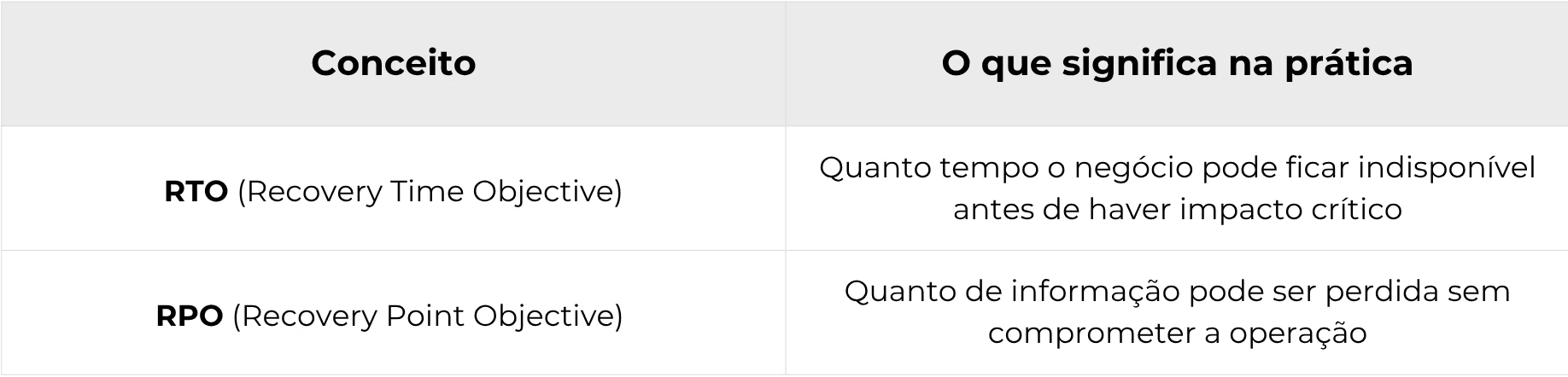
More than technical terms, RTO and RPO help translate technology decisions into real business impact.
Backup, in this context, ceases to be just an infrastructure task and becomes part of the continuity strategy.
In practice, this is how we handle backup at Pitang. As an ISO 27001 certified company, we structure our backup strategies aligned with business continuity, using practices such as:
Definition of policies according to the criticality of each system
Periodic review of backup frequencies
Regular restoration testing because a backup is only reliable when it works
Integration with business continuity plans (BCP)
Continuous monitoring of backup execution and integrity
In other words: having a backup is not enough. You must ensure that it works when needed.
What Really Makes a Difference When Something Goes Wrong
When an incident happens, certain factors recur among environments that manage to recover well versus those that face greater difficulty.
Having more than one layer of protection A single copy is rarely enough. More resilient structures consider different layers, distinct locations, and protection against local failures or attacks.
Testing before you need it This is perhaps the most critical point and also the most neglected. A backup that has never been tested is not a backup. It's an expectation. Simulating recovery scenarios is what brings clarity to what will actually happen when it's necessary.
Knowing what is critical Not everything has the same priority level. Understanding which systems and data are essential allows for defining smarter strategies and more realistic recovery times.
Integrating backup with security Today, many incidents are not technical failures; they are attacks. Without access control, versioning, and protection against unauthorized changes, the backup itself can be compromised.
Having continuous visibility It's not enough to set it and trust it. You need to know if backups are running, if they are complete, and if they can be restored.
A Backup That Works Is a Tested Backup
If there is one recommendation that applies to any organization, it is this: "Don't wait until you need the backup to find out if it works."
Today, IT backup is an essential part of how companies ensure continuity, security, and trust in an increasingly digital landscape.
In the end, the important thing is to ensure that even when something goes wrong—and yes, at some point it will—the business continues with less impact, greater predictability, and stronger response capabilities.
Continuously reviewing, testing, and evolving this strategy is what sets prepared environments apart from those that merely react.
If this topic is relevant to your context, it's worth taking a close look at how this strategy is currently structured. Because, ultimately, the question is not whether you have IT backup, but rather whether you can trust it.
At Pitang, we treat backup as part of the business continuity strategy, not as an isolated infrastructure routine. As an ISO 27001 certified company, we support organizations in structuring safer, more resilient environments prepared for the unexpected.
Speak with our Cloud team and discover how we can help:

FAQ: Frequently Asked Questions about IT Backup
What is IT backup and why is it important for businesses? IT backup is the creation of safety copies of data and systems to ensure recovery in the event of failures, attacks, or downtime. For businesses, it is essential because it protects operational continuity—without a reliable backup, a single incident can lead to financial losses, service interruption, and reputational damage.
Does being in the cloud eliminate the need for a backup strategy? No. Cloud providers operate under a shared responsibility model: they guarantee infrastructure security, but data protection and the backup strategy remain the organization's responsibility. Migrating to the cloud does not replace a well-defined backup policy.
What is the difference between RTO and RPO in the context of backup? RTO (Recovery Time Objective) defines how long the business can remain unavailable before suffering critical impact. RPO (Recovery Point Objective) defines how much data can be lost without compromising operations. Together, they help size the backup strategy based on the actual risk the company is willing to accept.
How often should backups be tested? There is no single interval that fits every organization, but the recommended practice is to perform restoration tests regularly—at least quarterly for critical systems, and whenever significant changes occur in the environment. A backup that has never been tested offers no real guarantee of recovery.
What can compromise a backup even when it exists? Several factors: lack of multiple protection layers, absence of restoration tests, backups stored in the same environment as original data, lack of access control and versioning, and absence of continuous monitoring. In cyberattack scenarios, the backup itself can be targeted if there is no proper isolation.
How can I tell if my company's backup strategy is adequate? The starting point is answering three questions: How quickly can we recover a critical system? What is the financial impact of prolonged downtime? Have backups been tested recently? If any of these answers are uncertain, the strategy likely needs a review.