
Blog, Pitang.

Marcelo Almeida - REVL
Offensive Cybersecurity: Why Just Reacting Is No Longer Enough
Cybersecurity

Offensive Cybersecurity: Why Just Reacting Is No Longer Enough
The traditional security model was built on a defensive foundation. Firewalls blocked malicious traffic, antiviruses detected known signatures, SIEMs correlated events to generate alerts. The goal was to detect threats and respond as quickly as possible.
For a long time, this approach worked. Attackers operated more noisily, environments were centralized, and the network perimeter was well defined.
But that reality has changed.
According to Mandiant's M-Trends 2025 report, the median time attackers remain in an environment before being detected—the so-called dwell time—was 11 days in 2024.
When detection depends on external alerts, that number rises to 26 days. And the more sophisticated the attacker, the quieter and more strategic the operation.
This data highlights a structural problem: when security relies solely on reaction, the adversary is almost always already ahead.
The Problem with Defense That Always Arrives Late
The logic of reactive security is, by definition, outdated. It depends on an event having already occurred for action to be initiated.
Meanwhile, attackers operate proactively: mapping the environment, identifying weaknesses, testing limits, and moving laterally until they find the most advantageous path.
Defending only by reacting means chasing the adversary. And, in cybersecurity, arriving later usually means arriving too late.
Three Structural Limits of Reactive Security
1. Alert Overload, Lack of Context
Tools like SIEMs, EDRs, and monitoring platforms produce massive volumes of data. The challenge is not the absence of information—it is the excess of noise.
Security teams deal daily with thousands of events. Most are false positives. Some are true, but of low impact. And, hidden within this volume, are the truly critical alerts.
Without context, analysts wear themselves out investigating irrelevant events while real risks go unnoticed. Having many alerts is not synonymous with visibility. It is informational overload.
2. Fragmented Perimeter
Reactive security was designed to protect well-defined boundaries. Today, applications are distributed across multiple clouds, employees access systems from anywhere, partner integrations create direct connections between environments, and APIs expose previously restricted functionality.
The perimeter is no longer a fixed boundary. It is fragmented.
Attackers no longer need to "enter through the front door." They exploit misconfigured APIs, leaked credentials, or existing internal flaws. Defending only the perimeter ignores the fact that the battle is already happening from within.
3. Lack of Visibility into Attack Chains
Sophisticated attacks rarely rely on an isolated critical vulnerability. They exploit the chaining of small flaws to build a complete compromise path: an overlooked endpoint, an API without adequate authentication, a credential with excessive permissions.
Reactive tools tend to analyze events in isolation. They detect isolated symptoms, but do not connect the dots or identify the emerging attack pattern. By the time a truly critical alert appears, the attacker has already traversed multiple stages.
Defending reactively is treating symptoms, not solving the root cause.
Speed of Business vs. Speed of Security
Modern organizations operate in increasingly rapid cycles of innovation. New services are launched frequently, infrastructures are continuously adjusted, and integrations emerge to enable urgent business demands.
Reactive security, however, does not keep pace with this speed. Audits are usually annual or semi-annual, tools take time to adapt to new vectors, and response processes still rely heavily on manual steps.
While business accelerates, security reacts slowly—creating exposure windows that attackers exploit with precision.
How Offensive Cybersecurity Changes This Landscape
This scenario is not just theoretical. It manifests daily in real, complex, and distributed environments.
Pitang identified this paradigm shift through its work on projects where defensive tools existed—yet risks remained invisible. It was from this experience that REVL was born, Pitang's offensive cybersecurity unit, focused on offensive security and threat intelligence.
The central premise: defensive controls remain fundamental, but become insufficient when operated in isolation, without context, and without anticipation.
What Sets the Offensive Approach Apart from the Reactive One
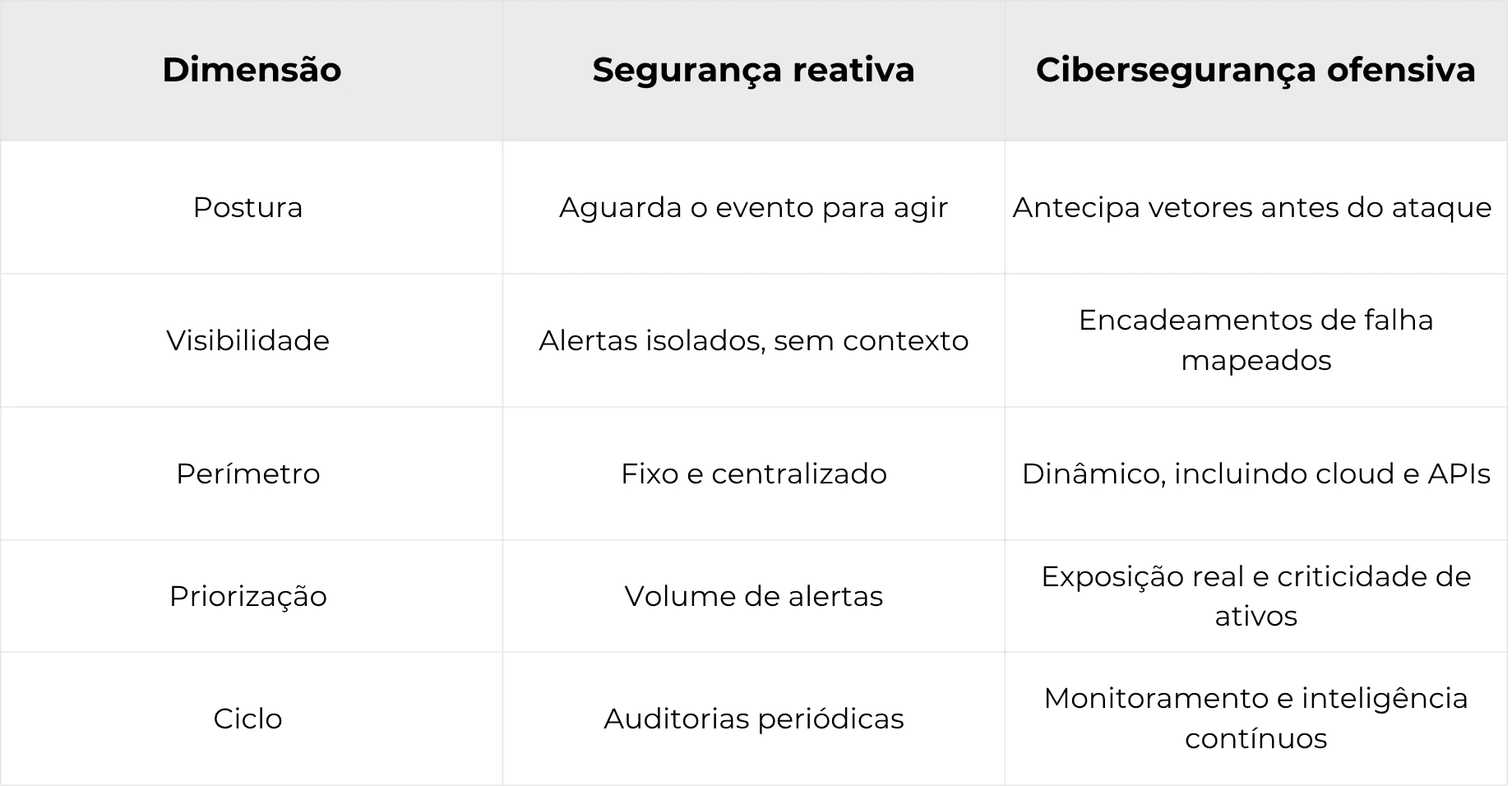
REVL's approach complements traditional defense by adopting the attacker's perspective, combining:
Contextual pentesting: simulations that demonstrate real business impact and reveal flaw chains that scanners do not detect
Continuous vulnerability management: context-based prioritization, not just CVSS, considering actual exposure and asset criticality
Applied Threat Intelligence: correlation between external indicators and the internal environment, anticipating emerging vectors
Attack surface visibility: dynamic mapping of exposures across cloud, APIs, and integrations
This combination transforms security from a reactive, operational cost center into a strategic enabler capable of sustaining innovation responsibly.
Security That Keeps Pace with Business Evolution
Purely reactive security has played its part. But in a landscape where attacks are faster, quieter, and more distributed, waiting for the adversary to act before responding is a strategy destined for delay.
Pitang, through REVL, works to enable organizations to operate with offensive intelligence—identifying risks before they materialize, prioritizing based on real context, and responding strategically.
Security ceases to be merely incident response and becomes continuous visibility and protection aligned with the speed of business.
Those who only react always arrive late. Those who anticipate set the rules of the game.
REVL is Pitang's cybersecurity unit, specializing in offensive security, threat intelligence, and vulnerability management. We combine technical expertise and strategic vision to reveal invisible risks and protect modern digital environments.

FAQ: Frequently Asked Questions about Offensive Cybersecurity
What is offensive cybersecurity and how does it differ from traditional security? Offensive cybersecurity is an approach that adopts the attacker's perspective to identify and exploit vulnerabilities before malicious actors do. Unlike traditional security—which waits for an event to react—the offensive approach operates proactively: mapping attack surfaces, simulating real compromises, and prioritizing risks based on context, not just alert volume.
What is dwell time and why does it matter for security strategy? Dwell time is the median time an attacker remains in an environment before being detected. According to Mandiant's M-Trends 2025 report, this figure was 11 days in 2024—and rises to 26 days when detection relies on external alerts. The longer the dwell time, the greater the potential damage. It is a direct indicator of the effectiveness—or lack thereof—of a strategy based solely on reaction.
What is contextual pentesting and why does it go beyond a vulnerability scan? Contextual pentesting is an attack simulation that considers the organization's real environment—its integrations, business workflows, and critical assets. While scanners identify isolated vulnerabilities based on known signatures, contextual pentesting reveals chains of flaws that, combined, create real compromise paths. The result is a view of risk that is much closer to what an actual attacker would exploit.
Why is vulnerability management based solely on CVSS insufficient? CVSS (Common Vulnerability Scoring System) provides a technical severity score, but does not consider the organization's context: which assets are actually exposed, the business criticality of each system, or whether there is any indicator of active exploitation. Prioritizing solely by CVSS can lead security teams to remediate high-scoring vulnerabilities that have low real-world impact, while lower-scoring flaws in critical assets remain unaddressed.
How do I know if my organization is still operating in a purely reactive mode? Several signs are indicative: annual or semi-annual security audits with no continuous monitoring in between; teams overwhelmed by alert triage without the capacity to investigate context; lack of dynamic attack surface mapping across cloud and APIs; and a lack of visibility into how individual flaws could be chained together by an attacker. If any of these points resonate, it is worth reviewing your security posture.