
Blog, Pitang.

Pitang Agile IT
AI and the Future of Work: What Changes for Professions and Companies
AI

AI and the Future of Work: What Changes in Professions and Companies
Artificial Intelligence is no longer a promise of the future. It is a present reality in companies, services, and professional routines.
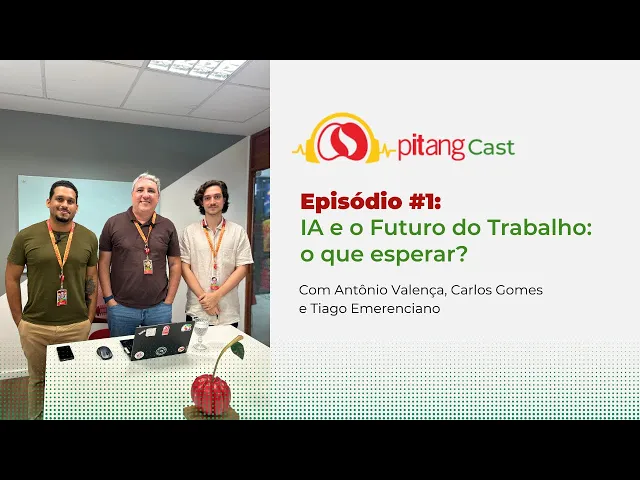
To discuss this impact in a clear and accessible way, we launched the first episode of PitangCast: "AI and the Future of Work: What to Expect?" — with Antônio Valença, CEO of Pitang, Carlos Gomes, Innovation Manager, and Thiago Emerenciano, Senior Dev.
In the episode, the three discuss how AI is transforming the way we work, what changes in the life of organizations, and which professional skills gain relevance in this new scenario.
In this post, we have gathered the main points covered and an invitation for you to listen to the full episode.
AI and the Future of Work: Transformation, Not Replacement
One of the most common misconceptions about AI is seeing it as a simple replacement for human tasks.
On PitangCast, the guests reinforce that AI should be seen as a technology that amplifies capabilities — not as an end in itself.
Yes, AI automates repetitive activities. But beyond that, it accelerates analyses, improves decision-making, increases productivity, and helps redirect human efforts toward more strategic and creative activities.
It’s not just about "letting machines work faster." It’s about rethinking processes, business models, and organizational culture itself.
Technology only makes sense when it empowers people to deliver more value, not when it simply replaces workflow steps.
How AI is Changing Professions
The impact of AI on professions is inevitable. Careers based on predictable, highly standardized tasks, or those dependent on fixed rules, tend to undergo heavy digitization.
However, it is important to reinforce: this does not mean the "end of jobs." It means a transformation of jobs.
Mechanical activities lose their central role. Human skills gain more relevance. And this shift from operational work to intellectual and creative work changes expectations, demands continuous upskilling, and creates room for professionals to position themselves more strategically within companies.
What Loses and What Gains Relevance
What tends to be automated | What gains value with AI |
Repetitive and standardized tasks | Critical analysis and strategic thinking |
Manual data processing | Creativity and innovation |
Execution based on fixed rules | Empathetic communication and collaboration |
Screening and sorting information | Systemic thinking and adaptability |
Routine operational reports | Context interpretation and decision-making |
The Most Valued Skills in the New Job Market
As AI becomes a natural part of workflows, the value placed on skills that no machine can deliver with excellence increases.
Creativity, innovation, empathetic communication, collaboration, the ability to adapt quickly, critical thinking, and strategic vision will become increasingly decisive.
These skills do not just complement the work of AI — they provide an ethical, human, and contextual direction so that technology is used with purpose.
In the future that is already happening, the differentiator won’t be competing with algorithms. It will be doing what they can never replicate: thinking with empathy, creativity, and humanity.
The Role of Companies in This Transformation
The responsibility of organizations in this process is significant. Technology does not grow healthily without culture, without prepared people, and without clarity about its impacts.
The future of work with AI requires companies to have:
Continuous training: allowing teams to keep pace with the evolution of AI
Transparency: ensuring everyone understands how technology impacts processes and decisions
Strategic review of workflows: integrating AI where it genuinely makes sense
Continuous learning environments: stimulating curiosity and development
Genuine appreciation of human talent: putting people at the center of decisions
AI should be an ally to empower teams, not a replacement for skills. That is the essence of Pitang's approach to innovation and transformation.
AI + Human: The Work Model of the Future
When properly applied, AI expands human potential, reduces bottlenecks, and frees up time for professionals to act in more creative, analytical, and strategic ways.
The combination of computational power and emotional intelligence creates a work model that is more efficient and, above all, better aligned with contemporary challenges.
The future of work will not be dominated by machines. It will be driven by people who know how to use AI as a partner.
Listen to the Full Episode of PitangCast
This post summarizes the main points, but the conversation goes much deeper.
In the full episode, Antônio Valença, Carlos Gomes, and Thiago Emerenciano dive into practical cases, share day-to-day perspectives, and answer questions that any professional or leader should be asking right now.
Pitang believes that technology and people walk hand in hand. If your company is thinking about how to integrate AI strategically and responsibly, talk to our team.

FAQ: Frequently Asked Questions about AI and the Future of Work
Will AI replace jobs or transform them? The prevailing trend is not the elimination of jobs, but the transformation of their content. Repetitive and rule-based tasks tend to be automated, while activities that require creativity, judgment, communication, and strategic vision gain more ground and relevance. The challenge for professionals and companies is to anticipate this shift through continuous upskilling and adaptation.
Which professions are most impacted by AI? Careers with a high concentration of predictable and standardized tasks — such as manual data processing, information sorting, and fixed-rule execution — tend to experience greater digitization. On the other hand, professions that combine technical skills with human capabilities such as empathy, creativity, and critical thinking tend to be strengthened in this scenario.
What skills should I develop to prepare for the future with AI? The most valued skills in the job market with AI are those that technology cannot replicate with excellence: critical thinking, creativity, empathetic communication, collaboration, adaptability, and systemic vision. In addition, knowing how to work with AI tools — understanding their limits, interpreting their results, and directing them with purpose — becomes an increasingly required cross-cutting skill.
How should companies prepare for the future of work with AI? The starting point is to treat AI adoption as a cultural transformation, not just a technological one. This involves continuously training teams, ensuring transparency regarding the technology's impact on processes, carefully reviewing workflows, and creating environments where continuous learning is part of the routine — and not an exception.
Are AI and the future of work relevant topics for all companies or only for large ones? For all. The transformation brought by AI does not distinguish by size or industry. Small and medium-sized enterprises that integrate AI strategically can achieve real productivity and competitiveness gains. The differentiator lies not in the size of the investment, but in having clarity on where the technology generates real value for the business and for people.


