
Blog, Pitang.

Diogo Monteiro
AI Adoption in Business: Why the Biggest Challenge Is Cultural, Not Technological
AI

AI Adoption in Enterprises: Why the Biggest Challenge Is Cultural, Not Technological
Artificial Intelligence is not just changing the products companies build. It is changing the way people work, make decisions, learn, and collaborate.
And here is an important point that many leaders still underestimate: the biggest challenge of AI adoption in enterprises is not technological. It is human.
Implementing AI in an organization doesn't just mean adding new tools, models, or automations. It means reshaping habits, processes, perceptions of value, and even the sense of psychological safety within teams.
That is why every AI-driven transformation is, first and foremost, a cultural transformation.
In this scenario, the role of the Product Manager takes on a new dimension: moving beyond being just the bridge between business and technology to also become a facilitator of organizational change.
Why AI Generates Resistance in Companies
Every AI adoption journey typically starts the same way: excitement and apprehension walking hand in hand.
On one hand, there is excitement about intelligent automation, productivity gains, personalized recommendations, autonomous agents, and new product possibilities.
On the other, silent questions arise that don't always surface in meetings:
"Will this replace part of my job?"
"How can we trust the model's answers?"
"What if the AI makes a mistake?"
"Will the customer actually accept this?"
These reactions are natural. And ignoring them is a strategic mistake. AI is not scary because it's complex. It is scary because it changes the game.
Change Management in AI Adoption: Where to Start
Leading change is not about convincing people that AI is amazing. It is about creating an environment where they can experiment, learn, and evolve safely.
The best product leaders understand that resistance is rarely about technology. Usually, it stems from a lack of clarity.
That's why effective change management in AI adoption begins by answering simple, yet fundamental, questions:
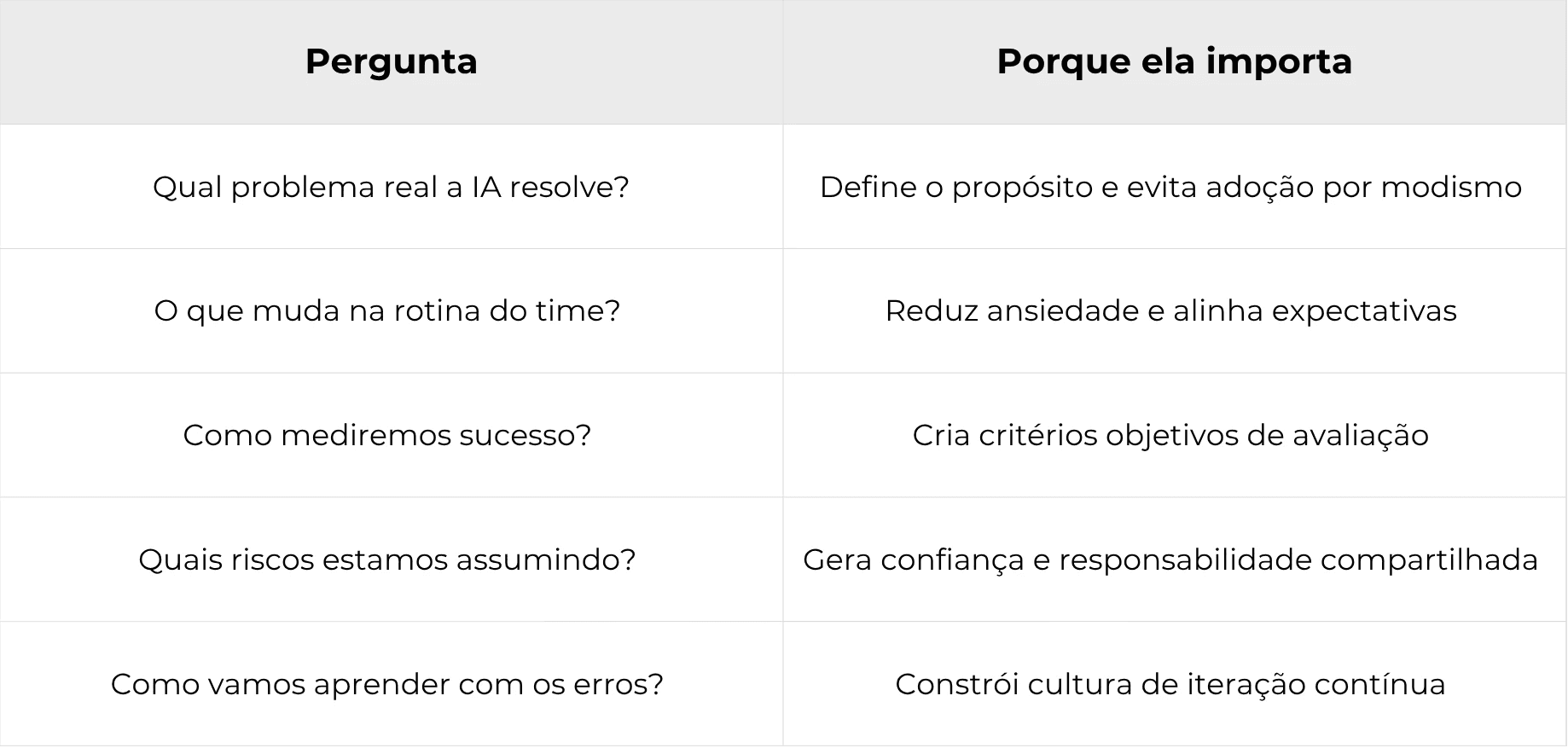
Without these answers, AI becomes just "another company initiative." With them, it becomes an integral part of the product vision.
AI in Enterprises Requires a Culture of Continuous Learning
There is a huge difference between "using AI" and "having an AI-ready organization." The first depends on tools. The second depends on mindset.
Teams that successfully adopt AI generally share several characteristics:
Psychological safety to experiment
Openness to learning fast
Controlled tolerance for error
Cross-functional collaboration
Decision-making based on data and hypotheses
Because working with AI involves constantly dealing with uncertainty. The model won't always answer correctly. The prompt won't always be ideal. The outcome won't always be predictable. And that's okay.
Maturity doesn't stem from perfection. It comes from the ability to iterate quickly without creating chaos.
A Framework for Leading Cultural Transformation with AI
McKinsey & Company has very interesting models for organizational transformation. Adapting this thinking to the context of enterprise AI adoption, there are four extremely useful pillars for Product Managers to lead this journey:
1. Model the Desired Behaviors
Culture always observes leadership behavior.
If leaders continue working exactly the same way as before while merely "demanding innovation," the implicit message is clear: AI is not yet part of real work.
When PMs and leadership use AI in their daily routines—whether for discovery, data analysis, prototyping, documentation, or prioritization—they legitimize the change.
Leading by example accelerates progress faster than any PowerPoint presentation.
2. Build Understanding Before Demanding Adoption
Resistance rarely stems from laziness. It stems from a lack of context.
People need to understand why AI is being adopted, what value it brings, what risks exist, and what boundaries have been established.
And there is an important detail here: storytelling works better than an overload of theory.
Showing a REAL case where AI reduced rework, accelerated analysis, or improved the user experience drives far more buy-in than dozens of slides on market trends. People connect with tangible impact.
3. Develop Skills Practically
There is no point in demanding change without equipping the team.
Many companies talk about AI in the enterprise, but few actually teach people how to work with it in their day-to-day context.
The best results emerge when learning is lightweight, continuous, and applied: quick workshops, hands-on sessions, prompt libraries, internal playbooks, real-use showcases, and cross-department knowledge sharing.
Technical confidence comes from practice, not theory.
4. Turn Learning into a Routine
Change only solidifies when it becomes a system.
Creating recurring spaces for learning and alignment helps AI transition from an "isolated novelty" to an everyday part of operations.
Some rituals that work exceptionally well:
AI Clinics: quick sessions to share key learnings
Biweekly reviews: tracking learnings and making adjustments
Internal experimentation forums: safe spaces to test and fail
Adoption scorecards: metrics tracking real AI usage across internal workflows
AI-focused retrospectives: what worked, what didn't
Dedicated Slack or Teams channels: continuous communication about developments
The goal isn't to create bureaucracy. It's to keep the momentum alive.
The Product Manager's New Role in the AI Era
In traditional transformations, the PM was already responsible for aligning business, technology, and user experience. In the AI era, they are also responsible for aligning trust.
This means operating across three fronts simultaneously:
1. Connecting purpose to practice
Before launching any AI-powered feature, the PM needs to answer a simple question: "Why does this really matter?"
The answer cannot simply be "because AI is trending." The team must understand what pain point will be resolved, what gain will be delivered, what experience will be enhanced, and what impact this will have on the customer.
Purpose reduces anxiety.
2. Translating complexity into clarity
While technical teams talk about embeddings, pipelines, inference, and latency, business departments talk about cost, risk, and ROI.
The PM acts as a translator between these worlds. When everyone understands the goal, the risks, the boundaries, and the success criteria, AI stops feeling like a "black box" and becomes a collective effort.
3. Sustaining the pace of transformation
Change management doesn't happen at a kickoff. It happens through repetition.
AI adoption demands consistency: frequent alignment, continuous communication, room for questions, constant reviews, and incremental learning.
Ultimately, culture doesn't shift through grand speeches. It shifts through small practices repeated every single day.
Tools and Rituals That Accelerate AI Adoption in Enterprises
For PMs and leaders driving this transformation, several initiatives tend to significantly accelerate organizational maturity:
AI Governance Board: a lightweight group with product, engineering, data, and legal to guide risks and decisions
Internal AI Playbook: centralize prompts, best practices, metrics, and real-world examples
AI Clinics: quick sessions to share learnings
Adoption scorecards: track indicators of actual AI usage in internal workflows
Transparent communication channels: keep the team updated on progress, mistakes, lessons learned, and next steps
Trust grows where there is transparency.
Ultimately, Leading AI Means Leading Learning
Change management in enterprise AI adoption isn't about forcing people to use new tools. It is about creating an environment where continuous learning becomes second nature to the culture.
The leaders who stand out in the coming years won't necessarily be the most technical. They will be the ones capable of turning curiosity into confidence, and confidence into organizational evolution.
Because AI does not replace human intelligence. It amplifies its reach. And companies that grasp this early will not only build better products; they will build teams that are more adaptable, more strategic, and far better prepared for the future.
At Pitang, we believe that digital transformation starts with people. If your company is taking its first steps in AI adoption or looking to scale existing initiatives, reach out to our team and discover how we can support this journey.

FAQ: Frequently Asked Questions About Enterprise AI Adoption
Why does enterprise AI adoption fail so frequently? Most initiatives fail not because of technical issues, but due to a lack of change management. When the team doesn't understand the purpose of the change, when there is no psychological safety to experiment, and when learning doesn't become part of the routine, AI remains confined to pilot projects that never scale.
What is the Product Manager's role in cultural transformation with AI? The PM becomes the link between purpose and practice. Beyond aligning business and technology, they are responsible for building trust—translating technical complexity into clarity for the team, tying every AI feature to a real customer pain point, and sustaining the momentum of transformation day in and day out.
How do you build an organizational culture prepared for AI? An AI culture is built on psychological safety to experiment, practical and continuous learning, recurring rituals (such as AI Clinics and retrospectives), real examples of impact, and leadership that models desired behaviors before demanding them from the team.
How long does it take for a company to be ready to adopt AI? There is no fixed timeline. Organizational maturity with AI is an ongoing process, not a destination. Companies that progress fastest are those that start with specific use cases, learn from the outcomes, and scale based on evidence—rather than those attempting to transform everything all at once.
How do you measure the success of AI adoption in an organization? In addition to technical metrics (model accuracy, latency, uptime), it is vital to track human adoption indicators: how many people use the tool regularly, how often, across which workflows, what business results were generated, and how the team perceives the delivered value.


